
Take the next step: 2026 VET Awards now open
Take the next step: 2026 VET Awards now open
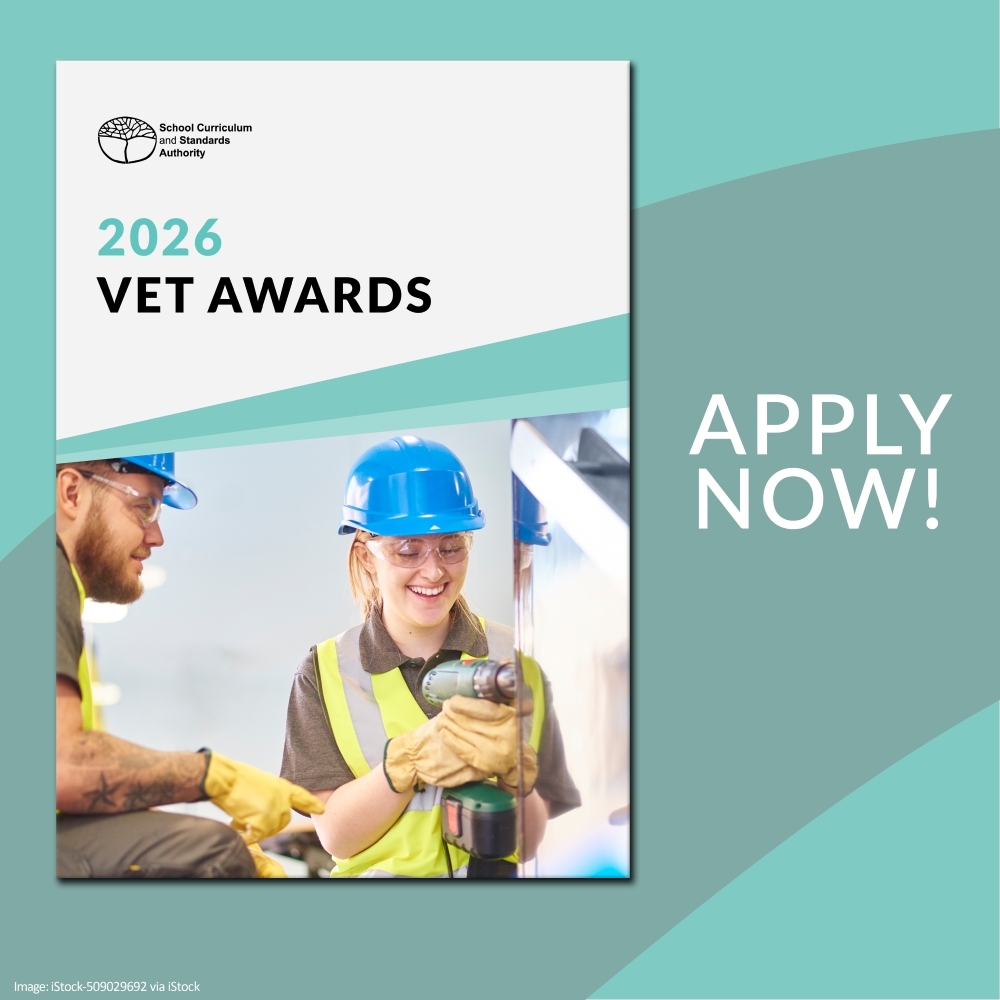
Nominations are open for the 2026 School Curriculum and Standards Authority (the Authority) VET Awards, recognising the achievements of Western Australian students who have demonstrated excellence in vocational education and training (VET) during their senior secondary years.
These awards celebrate students who have committed to developing practical skills, gaining industry experience, and taking meaningful steps toward their future careers.
Nominations are open for the 2026 School Curriculum and Standards Authority (the Authority) VET Awards, recognising the achievements of Western Australian students who have demonstrated excellence in vocational education and training (VET) during their senior secondary years.
These awards celebrate students who have committed to developing practical skills, gaining industry experience, and taking meaningful steps toward their future careers.
Why VET Awards?
The VET Awards provide students with the opportunity to showcase their skills, knowledge and workplace experience. Beyond recognition, the process empowers students to strengthen their confidence, communication, and interview skills, all of which are highly valued by employers and training providers.
Across multiple industry areas, the VET awards highlight students who are making the most of their VET pathway and preparing themselves for real-world success.
Student pathways in action
Each year, students across Western Australia demonstrate how VET can open real pathways into both employment and further study. By combining practical skills with industry experience, students are able to explore career options, build confidence and take meaningful steps toward their future.
Stephanie’s pathway into trades
Stephanie has always been drawn to practical, hands-on learning and enjoys working with tools and solving problems. During senior secondary school, she enrolled in a Certificate II in Plumbing, where she developed foundational skills and gained an understanding of the trade.
Through her workplace learning placement, Stephanie had the opportunity to work with Max, who runs a commercial plumbing business. This experience gave her exposure to active commercial sites and an understanding of how plumbing systems are installed and maintained in large-scale environments. It also introduced her to the expectations of working in a professional team and following workplace processes.
Like many students transitioning into a trade, Stephanie initially found the pace and demands of the job challenging. Adjusting to early starts and the expectations of a live worksite required resilience and adaptability. Over time, she built confidence in her abilities and became more comfortable contributing to day-to-day tasks.
Max was impressed by Stephanie’s work ethic and her willingness to take initiative onsite. He noted her ability to ask questions, respond to feedback, and look for ways to contribute, even when undertaking unfamiliar tasks. Her reliability and positive approach made her a valued member of the team and demonstrated her readiness for further training in the industry.
Recognising her commitment and progress, Stephanie’s VET Coordinator encouraged her to apply for the VET Awards. Following the selection process, Stephanie was awarded a Certificate of Excellence in her industry area.
Stephanie completed her Certificate II in Plumbing and commenced a school-based apprenticeship with Max’s company, allowing her to continue developing her skills while completing her secondary education and moving directly into paid employment in the plumbing industry.
Stephanie’s pathway highlights how VET can support students to transition confidently into employment while building a strong foundation for a long-term career in a skilled trade.
James’ journey into healthcare
James has long been interested in pursuing a career in healthcare, following early experiences with a family member receiving care in hospital. During senior secondary school, he enrolled in a Certificate III in Health Services Assistance via a school-based traineeship, where he developed practical skills and knowledge relevant to the healthcare industry.
As part of his qualification, James completed a clinical work placement in his local hospital, where he worked under the supervision of a nursing team. This experience provided him with valuable insight into patient care and the realities of working in a hospital setting.
Like many students entering a healthcare setting for the first time, James initially found it challenging to adapt to the pace and expectations of the workplace. Over time, he built confidence in his communication skills and became more comfortable interacting with patients and working as part of a team.
Jenny, a Registered Nurse who supervised James during his placement, recognised his natural ability to make both patients and colleagues feel understood and supported. Jenny noted his strong sense of empathy and professionalism in a clinical setting and provided a highly supportive reference for his VET Awards nomination.
Recognising his progress and dedication, James’s VET Coordinator also supported his nomination for the VET Awards. Through the selection process he was able to reflect on his learning and future goals within the healthcare industry.
Following the completion of his Certificate III and clinical work placement, James has been accepted into a Diploma of Nursing at his local TAFE post Year 12 and has been offered part-time work as a nursing assistant, allowing him to continue building his skills while studying.
James’s pathway highlights how VET can support students to gain practical experience, develop industry-valued skills and transition successfully into both further study and employment.
Connecting learning with opportunity
Stephanie and James represent just two examples of how VET supports students to explore career pathways, develop industry-relevant skills, and make informed decisions about their futures.
Strong partnerships between schools, training providers and industry ensure students have access to meaningful workplace learning and real career opportunities.
Eligibility and process
Students may be eligible for a VET Award if they:
- are enrolled as a full-time student in a registered Western Australian secondary school
- have satisfied the requirements for the Western Australian Certificate of Education (WACE)
- have completed a nationally recognised VET qualification at Certificate II or higher
- have undertaken at least two unit equivalents of Authority-Developed Workplace Learning (ADWPL) in a related industry area.
Following nomination, eligible students may be shortlisted for interview, where they can demonstrate their skills, knowledge and experience in their chosen field.
Key dates
- Nominations open: Friday, 3 July 2026
- Nominations close: Monday, 31 August 2026 (4:30 pm)
- Interviews: Tuesday, 13 – Thursday, 15 October 2026
- Beazley Medal: VET interview: Tuesday, 1 December 2026
- Award winners announced: December 2026
- Awards ceremony: February 2027
Ready for the VET Awards?
If you are a student committed to your VET pathway, or a school supporting high-achieving students, now is the time to prepare for nomination.
Speak with your VET Coordinator to ensure all requirements are met and documentation is submitted before the closing date.
The 2026 VET Awards are an opportunity to recognise your achievements and take the next step towards your future.
For further information and to submit an online nomination, visit the ‘Awards for outstanding achievement in VET’ concertina at the bottom of the Exhibitions and Awards page at https://senior-secondary.scsa.wa.edu.au/certification/exhibitions-and-awards.
Contact:
Phone:
Email: